

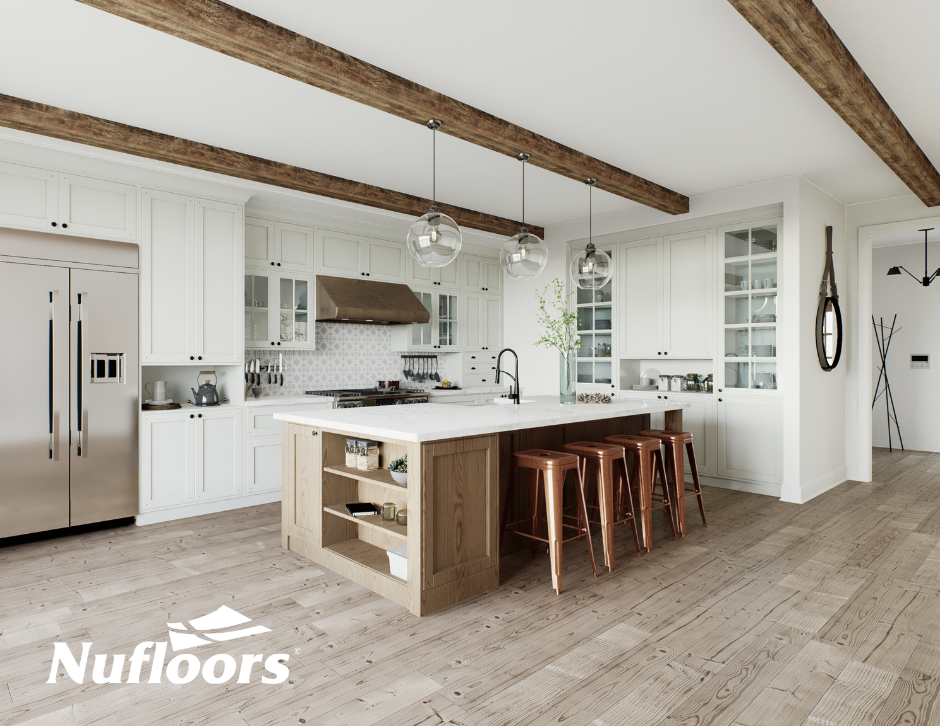
In a kitchen with wood cabinetry, the floor becomes part of a larger conversation. Cabinet doors stand vertically, catching light at eye level, while floorboards carry their grain across the room. Even when both surfaces use the same species, they can look quite different once installed.
The most satisfying combinations give each surface a clear role. The cabinets might be the feature, with a quieter floor beneath them, or the flooring might introduce character around simple cabinet fronts. We find it helps to decide which material you want to notice first.
Contrasting Grain in Wood Flooring and Cabinets
Grain can make two wood surfaces feel more alike or more distinct, regardless of their colour. Straight-grained cabinet fronts have a measured appearance, particularly when the grain runs consistently across adjacent doors. A floor with knots and sweeping grain introduces a more informal element beneath them.
The reverse pairing can work just as well. Expressive cabinet fronts benefit from flooring with less variation, giving the eye somewhere to rest. This is especially useful in a kitchen where the cabinetry occupies several walls.
Think about the countertop at the same time. Strong movement in the cabinets, floor and stone can create three competing features. Choosing one dominant pattern lets the remaining materials support it. A plain countertop, for example, can provide a welcome pause between wood fronts and a characterful floor.
Different Scales for Different Surfaces
A cabinet door and a floorboard present wood at very different scales. Narrow floorboards create frequent joints, while broad planks produce longer, less interrupted sections. Those lines interact with drawer stacks, door frames and the divisions between cabinets.
In a kitchen with detailed cabinetry, a less intricate floor layout can keep the room from feeling crowded. Flat-front cabinets leave more room for a floor with a distinct pattern or pronounced board variation.
The island deserves separate consideration. It interrupts the floor and introduces another substantial surface, often visible from adjoining rooms. A painted island can break up a kitchen filled with wood, while a wood island may become the feature against painted perimeter cabinets.
We recommend looking at elevations and the floor plan together. That makes it easier to understand how much of each material will actually be visible.
Breathing Room Between Wood Finishes
Painted walls, countertops and upholstery help separate wood surfaces visually. Their placement matters as much as their selection. A light countertop draws a clear line above wood cabinets, while a painted wall around open shelves prevents the timber from filling the entire view.
Exact matching is rarely the only route to a cohesive room. Existing dining furniture can belong comfortably beside new wood flooring when the pieces have a deliberate relationship through their shape, finish or overall style.
Looking for new or replacement flooring? Visit your local Nufloors flooring store in Grande Prairie to look at samples and speak to our experts. We'll help you get just the right material for the project.